
Fourth Sunday of Lent
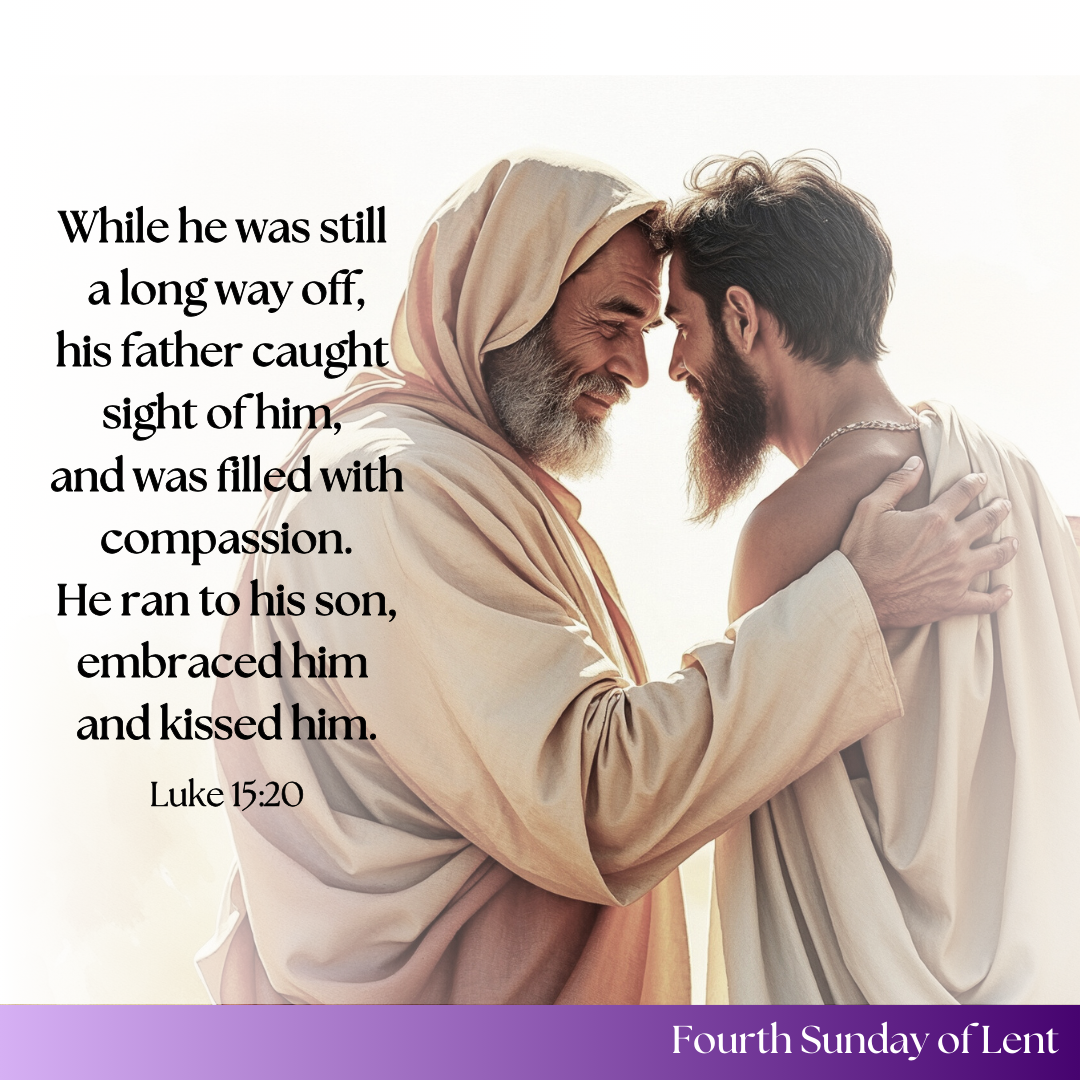
This one of the most beloved parables in the Bible. It illustrates Jesus’s desire for conversion to faithfulness and his forgiveness of sin.
Read this week’s readings here.
Share of the Estate
In those days, in Jewish society, when the father of the family died, the estate was divided into portions. The eldest son received a double portion, and the younger sons, a single portion each. This family only had two sons. So, when the younger son asked for his share of the estate, he received one third of his father’s net worth at the time, as opposed to the two thirds due to the elder son. The younger son was essentially saying that he could not wait for the older son to die, so he could have his money. The father complied with this seemingly odd and rather insulting request.
The Grass is Not Always Greener
Repentance for sins is the important step toward conversion and holiness. While While the parable only states “a distant land,” all the lands surrounding and including Israel were controlled by the Roman Empire. Roman pagan society permitted many things that Jewish society did not. While prostitution was considered shameful by the Romans, it was legal, and human trafficking was often hand in hand with the practice. The younger son went off into the pagan world and was seduced by what was available for him there. There was a lot to experience as long as he had the money, but When the money ran out, he learned the humiliation that came with being lower class in Roman lands.
The Older Son
The older son’s upset and anger at the situation is understandable. He was faithful to the father, and yet, this boy comes back and he is welcomed? He feels slighted, and angry. He is envious of the attention his brother is getting. The lesson here is how envy and jealousy can turn a good and faithful person quickly down the wrong path. These are intense feelings, that while they can happen to all of us, we must control them in order not to allow ourselves to turn down a dark path. Without the father’s quick reassurance to the older son, the two sons could have easily become enemies.
Consequences
In the father’s reassuring conversation to the older son, where he says “everything I have is yours,” in Luke 15:31, the father shows the true consequence of the younger son’s actions. While the younger son’s return to faithfulness in Jewish society, and to his father specifically, is celebrated, there is still the reality that the younger son squandered his inheritance. The father had no plans to divide the estate again. The younger son will have to find his own way to earn a living without the assistance of the money that was spent. This is teaching us that while God will forgive us our sins, the natural consequences of our actions are still a reality. Sin often has financial and relationship consequences, which will need hard work to repair.
Look Here for More
These links are articles I used for researching the Friday Update.
https://www.ncregister.com/blog/12-things-you-need-to-know-about-the-prodigal-son
https://ncec.catholic.edu.au/faith/scripture-resources/commentaries/the-gospel-of-luke/luke-1511-32/
https://ncec.catholic.edu.au/faith/scripture-resources/commentaries/the-gospel-of-luke/luke-1511-32/
I also use the USCCB NAB Bible and its footnotes extensively.